The easiest way to make cannabis edibles at home is to decarboxylate your flower in the oven, infuse it into butter or oil, and then use that infusion in any recipe you’d normally make with fat. Plan on about two hours for the infusion, mostly hands-off, and a beginner can pull it off with a baking sheet, a saucepan, and a strainer.
Decarboxylation matters because raw cannabis contains THCA, which doesn’t produce the effects people associate with edibles. Gentle heat converts it to THC, and the fat you infuse into carries it into whatever you bake or cook. Skip that step and even a perfectly made brownie will fall flat.
Cannabis cooking has deep roots, from bhang preparations in South Asia to the infused butter that home bakers have passed around for generations. The method hasn’t changed much. What has changed is how much we know about dosing, and that’s where beginners most often go wrong. Edibles take 30 to 120 minutes to kick in, and a common story is someone eating a second piece because nothing happened yet. Start low, wait, and label everything.
Below you’ll find what to gather, the safety basics, the step-by-step process, three beginner recipes, and a way to check that your batch turned out the way you intended.
What You Need Before You Start: Tools, Ingredients, and Lab-Tested Flower
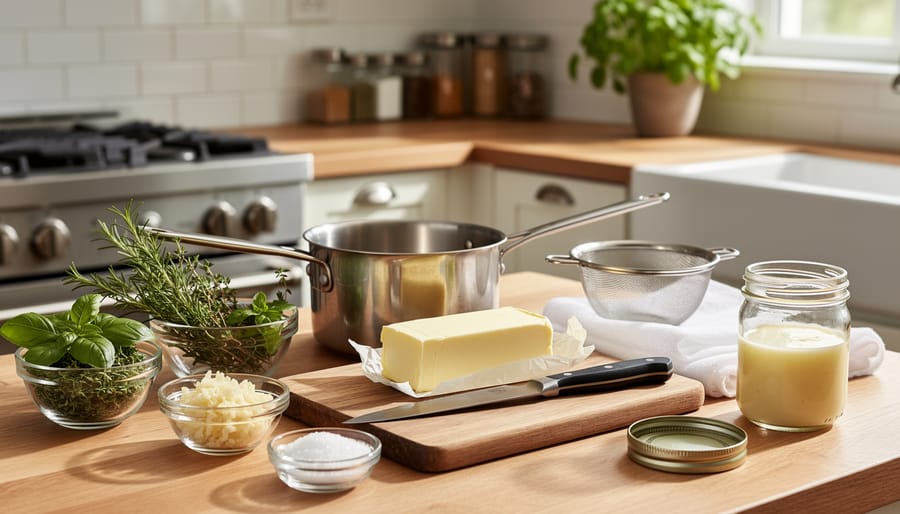
Choosing Your Starting Material
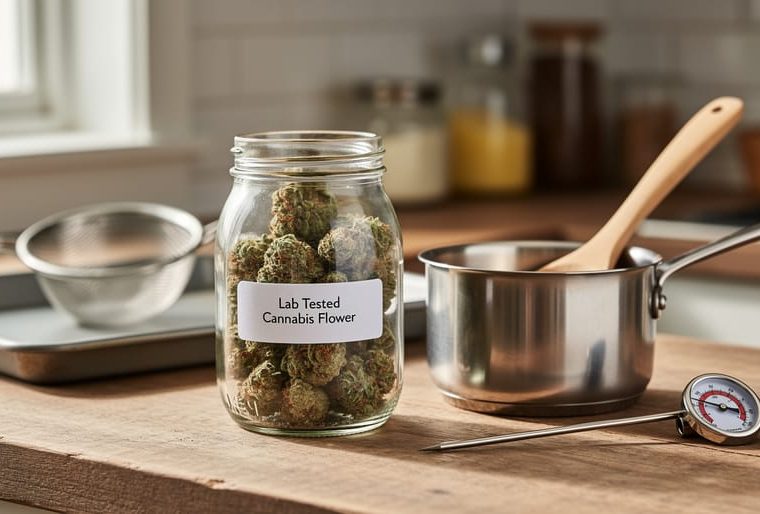
Start with the label. Lab-tested flower should list a THC or CBD percentage, and a certificate of analysis (COA) backs that number up. The COA is a report from an independent lab showing the cannabinoid content and often screens for contaminants like pesticides, mold, and heavy metals. If a product can’t produce one, pick something else.
THC-dominant flower is what most people mean by “weed,” and it’s the compound responsible for the intoxicating effects. CBD-dominant flower is low in THC, so it won’t feel the same way, which makes it a gentle place to practice your technique before working with stronger material.
That’s why beginners often choose lower-potency flower, roughly in the low-to-mid teens for THC or below. Infusing concentrates the cannabinoids into a whole batch, so strong starting material can produce a surprisingly strong result. If you’re curious how high potency products compare, it’s worth reading up before you ever reach for them.
Butter, Oil, or Honey: Picking a Carrier
Cannabinoids like THC and CBD are fat-soluble, meaning they dissolve into fats rather than water. That’s why most infusions start with butter or oil: the fat carries the cannabinoids out of the plant material and into something you can bake or cook with.
Butter is the classic choice. It tastes rich, works in nearly any baked good, and is easy to find. Coconut oil handles higher-fat recipes well and stays stable at room temperature, though its flavor comes through. Olive oil suits savory dishes like dressings and sautés, but its taste can clash with sweets. Honey-based infusions are a bit different, since honey contains little fat, so they usually rely on a fat-based infusion or a tincture stirred in. They work well in tea or drizzled over oatmeal.
Cooking with cannabis is far older than dispensaries. Cannabutter echoes traditions like bhang in South Asia, a cannabis preparation blended into milk-based drinks and sweets and shared during festivals such as Holi.
Safety Warnings Every First-Time Home Cook Should Read
Edibles work on a different clock than smoking or vaping, and most first-time problems come from forgetting that. Effects commonly begin 30 minutes to 2 hours after eating, because the cannabinoids have to pass through digestion first. That delay is the reason “start low, go slow” is the golden rule of home cooking. Begin with a small portion, wait the full window, and only then decide whether you want more. Our guide to safe dosing goes deeper on portioning.
Picture a composite scenario. A new cook bakes a batch of brownies, eats one, and feels nothing after 45 minutes. Assuming the batch is weak, they eat a second. An hour later, both doses arrive together, and the evening turns uncomfortable. Nothing went wrong with the recipe. The only mistake was impatience.
A few more habits keep everyone safe:
– Keep infused food away from children and pets, and label it clearly so no one eats it by accident.
– Don’t drive or operate machinery after eating an edible.
– Avoid mixing edibles with alcohol, which can intensify the experience unpredictably.
– Expect uneven distribution. Cannabinoids don’t spread perfectly through batter, so one brownie can be stronger than another. Stir thoroughly and cut evenly.
– Check local laws before making or sharing edibles. Rules differ widely, and understanding basic cannabis compliance helps you stay on the right side of them.
Finally, anyone taking medication or managing a health condition should talk with a healthcare professional before trying edibles.
Step-by-Step: How to Decarboxylate and Infuse Cannabis Butter
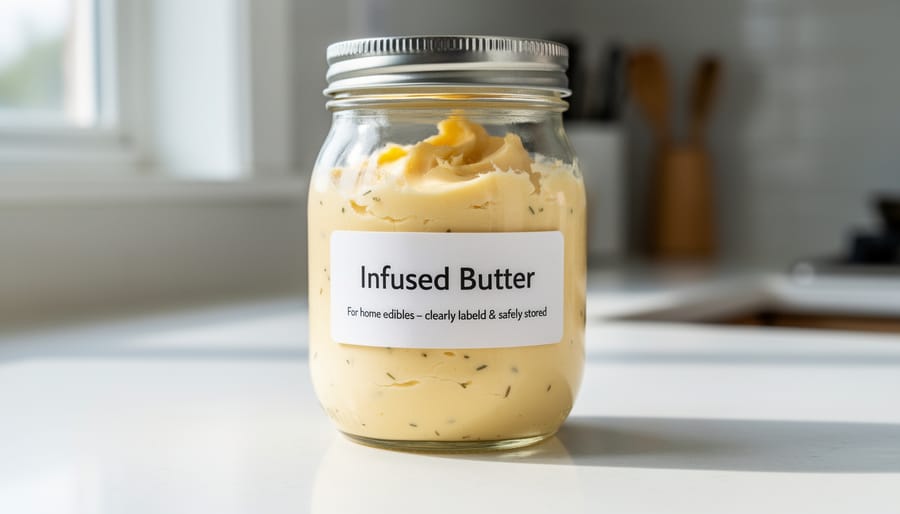
A Simple Way to Estimate Dose Per Serving
Start with the label on your flower. THC percentage times weight in milligrams gives you the maximum possible THC. Say you use 7 grams of flower labeled 20% THC. That’s 7,000 mg × 0.20 = 1,400 mg of THC. If you stir the finished butter into a pan of 16 brownies, divide 1,400 by 16 and you get about 87 mg per brownie. That’s far too strong for a beginner.
Treat that number as a ceiling, not a promise. Decarboxylation is rarely complete, and extraction pulls out only part of what’s in the plant. Some potency stays behind in the strained plant material. Ovens run hot or cool, too.
For a first batch, aim much lower. Many beginners start around 2.5 to 5 mg of THC per serving, so use less flower or cut smaller portions. Wait the full onset window before taking more.
Three Easy Recipes to Make With Your Infusion
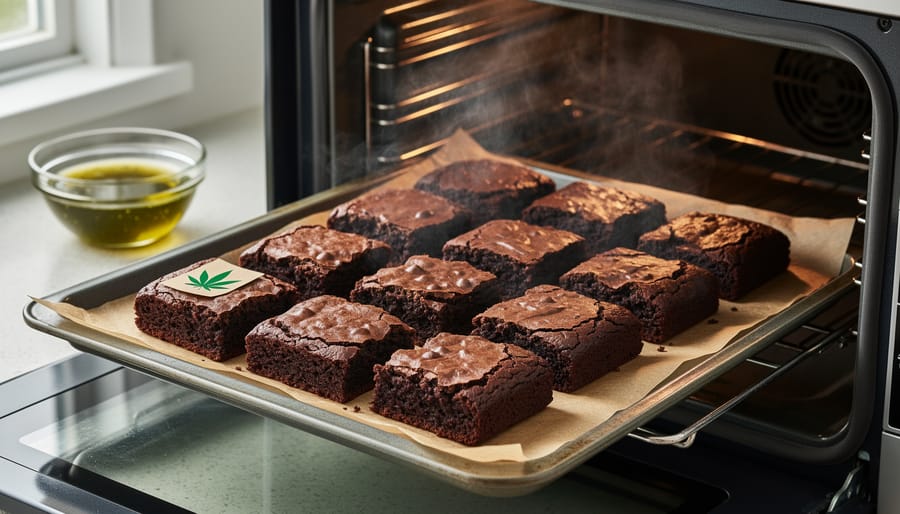
Once your infusion is ready, you don’t need new skills, just recipes you already trust. Treat the infused butter as one ingredient and keep the dose per serving low and consistent.
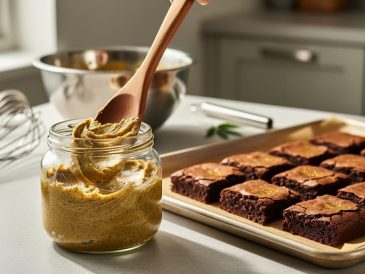
Fudgy Brownies (16 squares)
Ingredients: 1/2 cup infused butter (melted), 1 cup sugar, 2 eggs, 1 teaspoon vanilla, 1/3 cup cocoa powder, 1/2 cup flour, a pinch of salt.
Method: Whisk the melted butter with sugar, eggs, and vanilla. Fold in the dry ingredients until just combined, then bake in a lined 8×8 pan at 350°F (175°C) for 20 to 25 minutes.
Dosing tip: Divide your batch’s estimated total milligrams by 16, then cut the squares evenly. Chocolate hides the grassy flavor well, but cannabinoids settle unevenly, so stir the batter thoroughly.
Infused Garlic-Herb Butter Toast (4 servings)
Ingredients: 2 tablespoons infused butter, 2 tablespoons regular butter, 1 minced garlic clove, chopped parsley, 4 slices of bread.
Method: Warm both butters with the garlic over low heat for a minute or two, stir in the parsley, and spread evenly on the toast. Skip the broiler, since high heat can degrade cannabinoids.
Dosing tip: Blending with regular butter makes each slice easier to dose accurately. Spread the same amount on every piece.
Honey-Infused Oatmeal Bites (12 bites)
Ingredients: 1 cup rolled oats, 1/3 cup peanut butter, 1/4 cup honey, 1 tablespoon infused butter (melted), 1/4 cup chocolate chips.
Method: Stir everything together in a bowl, chill for 30 minutes, then roll into 12 equal balls. No oven needed.
Dosing tip: Weigh or measure the mixture so each ball is the same size. Equal portions mean equal doses.
Sharing Edibles Responsibly
Edibles are often passed around at gatherings, which is part of their appeal. In that setting, a plain-looking brownie can be mistaken for an ordinary dessert. Label every batch clearly with its contents, the estimated dose per piece, and the date made. Always tell guests what they’re eating before they take a bite, and let them decide for themselves. Keep a small portion size on offer, and remind everyone that effects can take up to two hours to appear.
How to Check Your Results and What to Try Next
A good batch starts with your eyes and nose. Properly strained infused butter should look fairly even in color, usually a pale green to golden hue, with no gritty plant bits settling at the bottom. It should smell warm and slightly herbal, not scorched or sharply bitter.
Then comes the part that takes patience. Taste a small test portion, such as a quarter of your planned serving, and wait the full onset window of up to two hours before deciding anything. Eating more too soon is the classic beginner mistake, especially since you may also be paying attention to memory effects and how clearly you feel the next day.
Use this checklist to refine each batch:
- Write down the flower weight, labeled THC percentage, carrier, and servings per batch.
- Note how the test portion felt at 30, 60, and 120 minutes.
- If it’s too weak, use a bit more flower next time or double-check your decarb time and temperature.
- If it’s too grassy, grind less finely, strain gently, and keep the simmer low.
- If it’s too strong, stir it into plain butter to dilute and cut your portions smaller.
- Store it airtight in the fridge, label it clearly, and keep it away from children and pets.
Where available, a licensed lab can test your finished infusion for potency, which beats home math. Once you’re comfortable, try CBD-dominant recipes, read up on terpenes and how they shape flavor, or browse the site’s training resources for the next step.
Easy Cannabis Edibles Recipes: Common Questions Answered
Do I have to decarb my cannabis?
Yes, if you want the effects. Raw flower contains mostly THCA and CBDA, which convert to THC and CBD with gentle heat. Skipping decarboxylation usually gives you a weak batch.
How long does infused butter last?
Treat it like regular butter, with extra care. Kept airtight and refrigerated, it generally holds for a few weeks, and freezing extends that considerably. Toss it if you see mold or notice off smells.
Why didn’t my edible work?
Common culprits are skipped or incomplete decarboxylation, low-potency flower, or uneven mixing. Remember that onset can take up to two hours, so wait it out before assuming a batch failed.
Can I use cannabis oil or tinctures instead of flower?
Often, yes. Already-activated oils and tinctures can be stirred into recipes, but check the label for potency and follow the product’s guidance, since concentrations vary widely.
How is CBD different from THC in recipes?
Both are prepared the same way, but THC is the compound associated with intoxication, while CBD is not. Always check the label to know which one your flower or oil is dominant in.
Is homemade dosing accurate?
Only roughly. Extraction efficiency and ingredient mixing vary, so treat your math as an estimate and start with small portions.
Rules about making and sharing edibles differ by location, so check your local laws first. If you take medication or have a health condition, talk with a healthcare professional before experimenting with any of these recipes.
Good cannabis edibles come down to a few habits done well: start with lab-tested flower, decarboxylate it carefully, infuse gently at a low temperature, and keep your servings conservative. Get those four things right and even the simplest brownie or herb butter turns out more predictable and a lot more enjoyable.
Safety is the thread that ties it all together. Edibles take their time, so wait out the full onset window before you even think about a second portion. Label everything clearly, store it well out of reach of kids and pets, and check your local laws before you make or share a batch.
Treat each batch as a small experiment. Jot down the flower you used, your carrier, your estimated dose, and how a portion felt. Over a few rounds, those notes will sharpen your instincts far faster than guesswork. Build your skills gradually, and keep exploring our other Cannabis Edibles Recipes and educational resources for what to try next.