
Online cannabis certification programs are structured educational courses that prepare individuals and business teams for roles in the legal cannabis industry, typically covering topics like compliance, product safety, responsible sales practices, and state-specific regulations. Unlike traditional college degrees, these programs focus on practical, industry-specific knowledge that professionals can apply immediately in dispensaries, cultivation facilities, testing labs, and manufacturing operations.
The cannabis industry’s regulatory landscape makes certification particularly valuable for both job seekers and employers. Many states require or strongly encourage cannabis workers to complete specific training before handling products or interacting with customers. Business owners often implement certification requirements across their teams to reduce compliance risks and ensure consistent understanding of dosing guidelines, contamination prevention, and age verification protocols. For individuals entering the field, certification demonstrates foundational knowledge that can distinguish candidates in a competitive job market.
These programs vary widely in scope and depth. Some focus narrowly on budtender certification or responsible vendor training, similar to alcohol server permits. Others offer comprehensive cannabis business management curricula spanning cultivation science, extraction methods, quality control, and local regulatory frameworks. Completion timeframes range from a few hours for basic compliance courses to several months for advanced professional certificates.
This article explains how online cannabis certification programs function, what types of credentials exist, and how to evaluate whether a particular program aligns with your career goals or business needs. Whether you’re considering certification for yourself or establishing training standards for your staff, understanding the structure and practical applications of these programs helps you make informed decisions in a rapidly professionalizing industry.
What Online Cannabis Certification Programs Mean for the Industry
Online cannabis certification programs are structured educational courses delivered through web-based platforms that teach cannabis industry professionals about compliance, safety protocols, product handling, and regulatory requirements. Unlike state-issued business licenses or employee badges, these certifications represent verified completion of specific training modules, proof that a person or team has studied and demonstrated knowledge in a particular aspect of cannabis operations.
The programs are typically offered by industry associations, compliance consultancy firms, specialized education companies, and occasionally by state regulatory bodies themselves. They range from general introductions to cannabis law to highly specialized courses on topics like edibles manufacturing safety or inventory tracking systems. As the cannabis industry has moved from gray-market operations to regulated commerce, the need for standardized, verifiable training has become apparent to both regulators and business owners.
- Certification vs. License
- A certification is proof of completed training and knowledge assessment, while a license is legal permission from a government authority to operate or work in the cannabis industry. You need a license to legally participate; certification demonstrates competence.
- Compliance Training
- Instruction focused on understanding and following state and local cannabis regulations, including product testing, labeling, age verification, and record-keeping requirements. This training helps businesses avoid violations that can result in fines or license suspension.
- Accreditation
- Recognition from an authoritative body that a certification program meets established educational standards and is accepted as legitimate within the industry. Not all cannabis certifications are accredited, and standards vary by state.
- Continuing Education Units (CEUs)
- Credit hours earned through ongoing professional education that some states or employers require to maintain certification status or demonstrate up-to-date knowledge. Typically tracked annually or biennially.
It’s important to distinguish these programs from informal training. While on-the-job instruction and mentorship have value, certifications provide documented evidence of knowledge that regulators, insurers, and customers increasingly expect. They create a common baseline of understanding across an industry where regulations shift frequently and penalties for non-compliance can be severe.
How Online Cannabis Certification Programs Work

Course Delivery and Learning Formats
Most online cannabis certification programs use asynchronous learning, allowing students to complete video modules, readings, and assessments on their own schedule. This format works well for budtenders working evening shifts or manufacturers managing production schedules, you can pause a lesson mid-module and return when time permits. Courses typically remain accessible for several months after enrollment, letting you revisit material as needed.
Some programs incorporate synchronous elements like live webinars with compliance experts or scheduled Q&A sessions with instructors. These real-time components address complex regulatory questions and provide direct interaction, though they require blocking specific time slots. Programs often record these sessions for later viewing if you can’t attend live.
Mobile accessibility has become standard, with most platforms offering responsive designs or dedicated apps. You can review dosing guidelines during a lunch break or complete a quiz while commuting, though practical assessments involving detailed documentation work better on larger screens.
Programs accommodate different learning preferences through varied formats: visual learners benefit from diagram-heavy compliance modules, while kinesthetic learners engage with interactive case studies simulating real regulatory scenarios. Most courses combine multiple approaches rather than relying solely on text or video.
Assessment and Verification Methods
Online cannabis certification programs use multiple testing formats to ensure participants genuinely understand the material. Most programs combine knowledge checks, multiple-choice quizzes after each module, scenario-based questions that present real compliance situations, and case studies requiring written analysis of regulatory problems. Advanced programs include practical assessments where participants must demonstrate tasks like calculating THC dosages for edibles batches or identifying labeling violations on sample packaging.
To maintain credential integrity, reputable programs implement identity verification throughout the course. This typically includes requiring government-issued ID verification at enrollment, randomized webcam check-ins during exams, keystroke pattern analysis to detect unusual test-taking behavior, and timed assessments that prevent outside assistance. Some state-recognized programs require proctored final exams, either through live remote proctoring services or at designated testing centers.
The verification rigor varies by program purpose. Basic awareness courses may use simpler verification, while standardized training programs that satisfy state requirements typically enforce stricter protocols. Programs designed for compliance officers or quality control managers often include supervised practical components where instructors evaluate real-world application skills before issuing credentials.
Types of Cannabis Certification Programs Available
Compliance and Regulatory Training
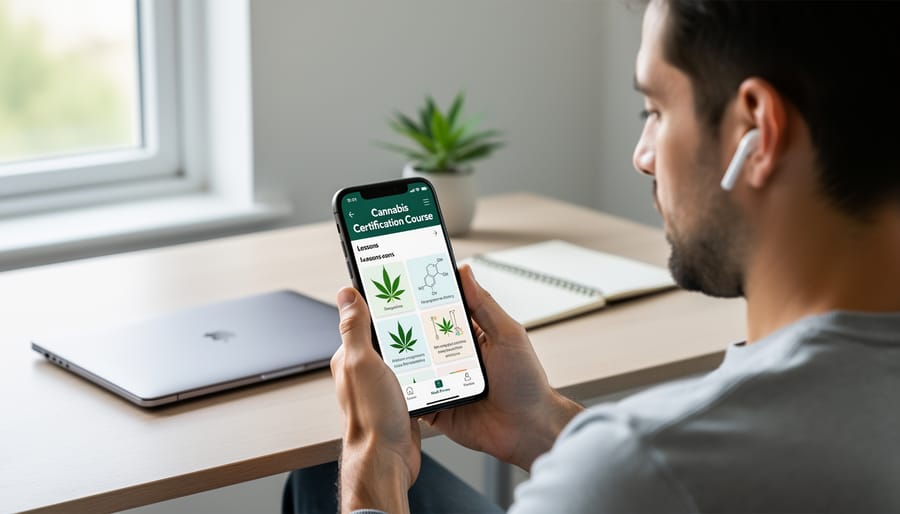
Compliance-focused certification programs address the regulatory framework that governs cannabis operations in each state. These courses cover topics such as packaging and labeling standards, product testing requirements, inventory tracking protocols, and age verification procedures that employees must follow during transactions. Because cannabis regulations vary significantly by jurisdiction, effective programs tailor their content to specific state laws rather than offering generic national overviews.
Many states now mandate or strongly encourage this type of training. Massachusetts, for example, requires all cannabis establishment agents to complete required responsible vendor training before they can work in a licensed facility. California and Colorado have similar requirements for different license types. Even when not legally required, businesses often pursue compliance certifications to prepare staff for regulatory audits and reduce the risk of violations that can result in fines or license suspension.
These programs typically include modules on recognizing compliant product labels, understanding THC limits for different product categories, maintaining proper records for seed-to-sale tracking systems, and responding correctly to inspection requests. Completion certificates demonstrate to regulators that a business has invested in professional training and takes its compliance obligations seriously.
Specialized Product Training
Specialized product training certifications target professionals working with specific cannabis formats, edibles, topicals, and concentrates, where precision and safety protocols differ significantly from flower cultivation or retail sales.
Edibles-focused programs teach dosing mathematics, infusion techniques, and shelf-stability testing. You’ll learn how to calculate THC distribution across batches, prevent hot spots in baked goods, and comply with maximum-dose-per-package rules that vary by state. These certifications address the unique challenge of delayed onset times and the importance of clear consumer labeling.
Topicals certifications cover transdermal delivery mechanisms, allergen management, and cannabinoid stability in creams and balms. Training emphasizes proper documentation of ingredient sourcing, contamination prevention during manufacturing, and accurate potency claims on packaging.
Concentrate programs focus on extraction safety protocols, solvent residue testing, and equipment handling for processes like CO₂ extraction or hydrocarbon methods. You’ll study purge techniques, terpene preservation, and the stricter purity standards concentrates face compared to other product categories.
Each product type carries distinct regulatory requirements around testing frequencies, label disclosures, and permitted additives. Specialized training ensures manufacturers understand these differences rather than applying one-size-fits-all approaches that can lead to compliance gaps or safety issues.
How Cannabis Businesses and Professionals Use These Certifications

For Business Owners and Operators
For business owners, online cannabis certification programs serve as a foundation for meeting state licensing requirements and maintaining operational compliance. Many jurisdictions require or strongly favor documented employee training, and completion certificates provide ready evidence during inspections and license renewals. By implementing organizational compliance training through certified programs, operators create consistency across locations and shifts, every budtender learns the same age verification protocols, every production worker follows identical safety procedures.
Standardized training reduces the risk of costly violations. When staff understand labeling requirements, dosing limits, and record-keeping obligations, the business faces fewer regulatory issues. Certification programs also enhance credibility with regulators and customers. A dispensary that can demonstrate certified staff signals professionalism and commitment to safety, which builds consumer trust and can differentiate the business in competitive markets. For multi-location operators, online programs offer scalability: new hires can complete training before their first shift, and existing employees can refresh knowledge as regulations evolve.
For Individual Professionals

Individual professionals use cannabis certification programs to strengthen their job market position and accelerate career progression. Budtenders with certification command higher starting salaries and advance to senior or supervisory positions faster than uncertified colleagues. Compliance coordinators and quality assurance specialists find certification particularly valuable, employers increasingly prefer or require documented training for these roles due to the regulatory consequences of mistakes.
Certification also opens lateral career moves within the industry. An edibles production worker who earns product-specific certification can transition into formulation or quality control roles. Similarly, retail staff who complete comprehensive compliance training become candidates for operations management or multi-location oversight positions.
For professionals entering from other industries, certification provides credible proof of cannabis knowledge that hiring managers recognize. It demonstrates commitment beyond curiosity and shortens the learning curve that concerns many employers. In competitive job markets, certification often determines who receives interview invitations and who gets filtered out during initial screening.
The credential’s value compounds as you accumulate experience, certification paired with hands-on work creates opportunities for consulting, training roles, or specialized positions that command premium compensation.
Choosing the Right Certification Program
Selecting a certification program requires evaluating several concrete factors to ensure the training meets your state’s requirements and delivers practical value. Start by confirming the program is recognized or accepted by your state’s cannabis regulatory authority, since some jurisdictions maintain approved provider lists or specific curriculum standards. If your state doesn’t mandate certification, prioritize programs with third-party accreditation from organizations like the American Herbal Products Association or state cannabis industry associations.
Examine the instructor credentials and curriculum development process. Effective programs employ instructors with direct regulatory experience, legal expertise in cannabis compliance, or backgrounds in food safety and manufacturing. Review course syllabi to confirm they address your state’s current regulations, not generic or outdated requirements. Programs that update content quarterly or notify students of regulatory changes demonstrate ongoing maintenance.
Check whether the program aligns with your specific operational needs. Budtenders require different knowledge than edibles manufacturers or compliance officers. A training framework designed for retail won’t adequately prepare someone working in production environments. Some operators find value in programs that help them build compliance standards across multiple roles rather than enrolling employees in separate courses.
Look for transparent pricing, clear completion requirements, and verifiable student outcomes. Programs should specify total hours, assessment formats, passing criteria, and certificate renewal terms upfront. Testimonials from businesses in your market segment or professionals in similar roles provide better insight than general endorsements. If possible, request a course preview or sample module before committing to enrollment fees.
The Role of Standardized Training in Cannabis Compliance
Standardized training has fundamentally reshaped how cannabis businesses approach regulatory compliance. Before certification programs became widespread, most companies relied on on-the-job training and individual interpretation of regulations, an approach that frequently led to inconsistent practices within organizations and across the industry. Formal certification establishes baseline competencies that employees can apply consistently, reducing the knowledge gaps that typically produce compliance failures.
When staff members complete structured programs covering product handling, labeling requirements, and documentation practices, businesses experience fewer regulatory violations. The reduction occurs because certified employees recognize compliance issues before they escalate into violations, understand the reasoning behind specific regulations, and apply consistent procedures across all operations. This systematic approach contrasts sharply with informal training, where crucial details often get lost or misinterpreted during knowledge transfer.
Standardized certification also builds consumer trust in ways informal training cannot. Customers increasingly expect professional standards in cannabis retail and manufacturing, particularly for edibles where dosing accuracy and ingredient transparency matter most. When businesses can demonstrate that their staff completed recognized training programs, it signals operational maturity and commitment to safety, factors that influence purchasing decisions in a crowded marketplace.
The compliance standards process becomes more efficient when multiple team members share the same foundational knowledge. Rather than starting from scratch with each new regulation, certified employees can integrate updates into existing frameworks they already understand. This efficiency translates into faster adaptation to regulatory changes and more cohesive compliance documentation during audits.
Common Questions About Cannabis Certification Programs
Certification costs vary widely depending on program scope and provider. Entry-level compliance courses typically range from $150 to $500, while comprehensive role-specific programs can cost $800 to $2,500. Many programs offer payment plans or employer-sponsored group rates that reduce per-person costs. Some state regulatory agencies provide free or subsidized training for specific compliance topics, though these usually don’t result in a portable credential.
Are cannabis certifications legally required?
Requirements vary by state and role. Some states mandate specific training for certain positions like compliance officers or managers, while others strongly encourage but don’t require certification. Check your state’s cannabis regulatory authority for current requirements.
How long does it take to complete a certification program?
Most online programs take 10 to 40 hours to complete, depending on depth and specialization. Self-paced courses let you finish on your own schedule, often within two to six weeks.
Do certifications transfer between states?
General cannabis knowledge transfers, but state-specific regulatory training typically doesn’t. If you move to a new state or operate in multiple jurisdictions, you’ll likely need additional training covering that state’s particular rules.
Will employers recognize my certification?
Recognition depends on the program’s reputation and relevance to the role. Certifications from established industry organizations or state-recognized training providers carry more weight than lesser-known programs.
Renewal requirements depend on the issuing organization and the type of certification. Many programs require renewal every one to three years, often with continuing education credits or a refresher course. Some states mandate annual recertification for compliance roles to ensure professionals stay current with regulatory changes. Renewal fees are typically lower than initial certification costs, ranging from $50 to $200.
The time investment for renewal varies. Some programs require just a brief update module, while others mandate several hours of new coursework. Plan ahead for renewal deadlines, as expired certifications can affect employment eligibility in states where certification is required for specific positions. Most programs send reminder notifications 30 to 60 days before expiration.
Online cannabis certification programs have evolved from optional professional development into a practical foundation for navigating a regulated industry. As cannabis operations face tighter oversight and consumers demand greater transparency, standardized training provides a framework for both compliance and business credibility. These programs offer more than regulatory checklists, they build institutional knowledge that helps teams respond to audits confidently, reduce costly mistakes, and maintain consistent product quality.
The certification landscape remains diverse, ranging from broad compliance overviews to specialized training in edibles production, topicals manufacturing, or state-specific regulatory requirements. This variety reflects the industry’s complexity and the different challenges facing a budtender, a compliance officer, and an edibles manufacturer. Choosing the right program means matching your specific operational needs to the curriculum’s focus, verifying state recognition where applicable, and confirming that the credential will actually strengthen your position in your market.
For businesses, certification serves as documented proof of training when regulators ask questions. For individual professionals, it signals competence in a competitive job market. Whether you’re launching a new operation or professionalizing an existing one, investing in structured education tailored to your state’s requirements and your product focus typically pays off through fewer compliance headaches and stronger operational foundations. Start by identifying the specific regulations and product categories that apply to your situation, then seek programs that address those areas directly.